
 by
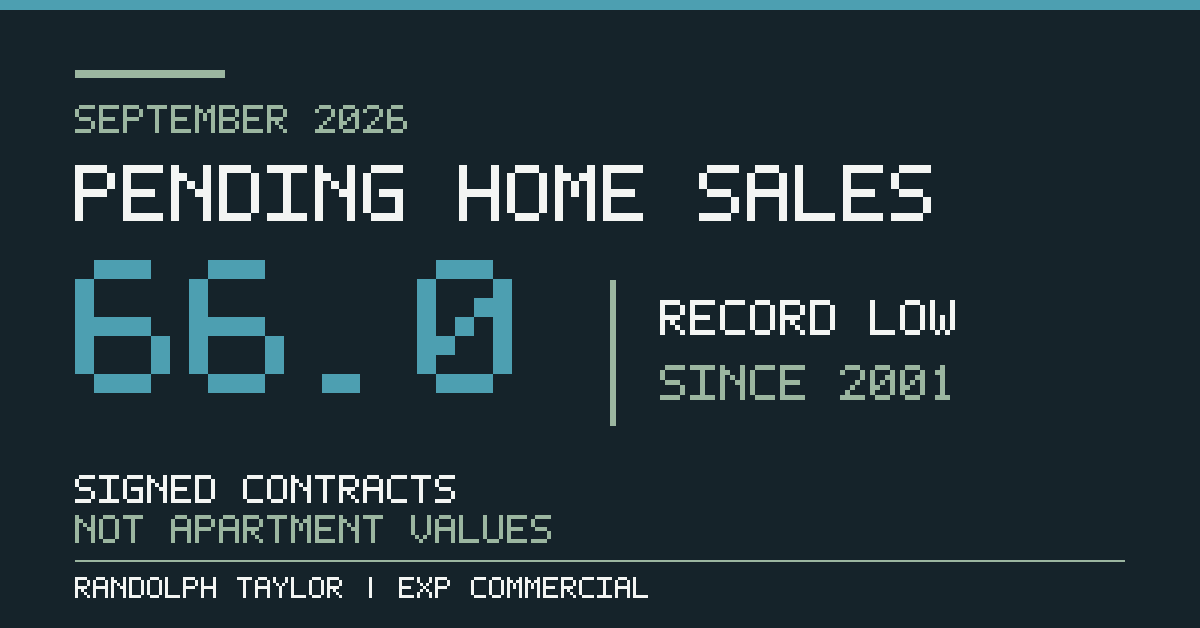
A record low in U.S. home-purchase contracts is an important housing signal—but it is not a record low in Chicago apartment values. On October 20, 2026, the National Association of REALTORS® reported that its seasonally adjusted Pending Home Sales Index fell to 66.0 in September, the lowest reading since the series began in 2001. Contract activity declined 7.3% from August and 11.3% from September 2025. The report measures signed contracts for existing residential homes, not closed sales, home prices, or multifamily investment transactions.
For owners of two- to four-unit buildings and larger apartment properties in Chicago, Aurora, Naperville, DuPage County and surrounding suburbs, the decision is more nuanced: slower homebuying can affect renter tenure, while higher financing costs can independently constrain what investment buyers can pay. Neither effect can be quantified from the national index alone.
What the September pending-sales record actually measures
The Pending Home Sales Index tracks signed purchase agreements on existing single-family homes, condominiums and co-ops. It is a leading indicator because many transactions close one or two months later, although financing, inspection and appraisal contingencies can change outcomes. Its September reading of 66.0 is an index level, not a percentage of homes sold. The 7.3% decline is the seasonally adjusted month-over-month change; the 11.3% decline is the year-over-year comparison.
According to the October 20 NAR release, all four U.S. regions recorded lower contract activity. The Midwest declined 6.5% month over month and 8.7% year over year. The national index does not establish that Chicago apartment prices, apartment transaction volume or property-owner distress reached record lows.
Chicago’s completed residential sales tell a different story
Illinois REALTORS’ September 2026 housing-market tables, released in the October 22 reporting cycle, measure closed residential sales rather than signed pending contracts. For the Chicago metropolitan reporting area, September recorded 7,326 closings, down 3.5% year over year, while the median residential sale price was $385,000, up 6.9%. Within the City of Chicago, there were 1,681 closings, down 7.2%, with a $389,900 median sale price, up 8.3%.
Those figures illustrate why activity and price cannot be used interchangeably. Fewer completed home transactions can coexist with higher median prices. They also cover a different geography and property universe from the national pending-sales index. Neither series directly prices a 12-unit Aurora property, a Naperville four-flat or a suburban apartment portfolio.
What local rental fundamentals suggest—and what they do not
Chicago-area rental demand cannot be inferred solely from homebuyer activity. The October 15 Realtor.com September 2026 rental report placed median advertised asking rent for studio, one- and two-bedroom listings in the Chicago–Naperville–Elgin metro at $1,909, up 2.3% year over year. Its reported concession share was 22.5%. That series includes apartments and privately rented condos, townhomes and single-family homes; it is not an apartment-only rent roll or a direct substitute for verified unit-level rental comparables.
For a property owner, elevated mortgage payments may keep some households renting longer, supporting retention or leasing demand. But a weaker purchase market can also reflect household uncertainty, affordability pressure or changing mobility. The relevant question is whether your property’s renewal rates, achieved rents, concessions, occupancy and turnover costs support stronger cash flow. Suburban markets such as Aurora, Naperville and western DuPage County should be evaluated against their own competitive set rather than a broad Chicago average.
Why stronger rental demand does not automatically increase investment value
Multifamily valuation depends primarily on sustainable net operating income, the quality of the income stream, capital needs and the terms under which qualified buyers can finance a purchase. A renter who delays buying a home may benefit apartment occupancy; a buyer financing an apartment building still faces underwriting tests for interest rates, debt-service coverage, leverage, insurance, taxes and replacement reserves.
Illustrative 16-unit example: A $100 monthly rent improvement on each of 16 units would increase annual scheduled gross rent by $19,200 (16 × $100 × 12). At an illustrative 5% vacancy/collection allowance, the incremental effective rental revenue would be $18,240 before incremental operating expenses. This is arithmetic, not a forecast or a claim about current market rents. Net operating income would increase by less if additional operating costs are required. A credible valuation must then test the actual NOI against prevailing buyer financing and return requirements; applying an invented cap rate to gross rent is not analysis.
For more on transaction preparation, see our Chicago multifamily sale-preparation guide and the multifamily refinance underwriting checklist.
Four owner decisions worth making now
- Reconcile the rent roll: compare actual collected rents, renewal outcomes, concessions and vacancy to recent, truly comparable local leases.
- Normalize operating expenses: review property taxes, insurance, utilities, repairs, management and reserves before relying on projected NOI.
- Test financeability: evaluate debt-service coverage and realistic buyer leverage using current lender assumptions, not historical financing terms.
- Compare hold, refinance and sale outcomes: quantify net proceeds, capital needs, transaction certainty and the opportunity cost of waiting.
Does the national record low mean Chicago apartment values have fallen to record lows?
No. NAR’s pending-home-sales index measures existing-home purchase contracts. Illinois REALTORS’ closed-sale statistics concern residential home transactions. Neither is a Chicago multifamily investment-sales price index. A defensible apartment valuation requires property-specific financials, relevant investment-sale comparables, rent evidence and current financing assumptions.
The bottom line for Chicago multifamily owners
September’s record-low pending home sales signal an unusually weak national home-purchase contract pipeline, not a blanket collapse in Chicago residential prices or apartment values. Local rental conditions may support well-operated multifamily properties even while debt costs narrow the qualified buyer pool. The practical response is to underwrite both sides of that equation and create a competitive, financeable disposition strategy when a sale is appropriate.
Randolph Taylor, MBA, CCIM, MiCP
Vice President | Multifamily Investment Sales Broker
eXp Commercial | National Multifamily Division
For a confidential property-specific valuation and sale strategy, visit creconsult.net.
Sources and scope: NAR, October 20, 2026 (September 2026 seasonally adjusted signed existing-home contracts); Illinois REALTORS/ShowingTime, September 2026 residential closed sales, October 22 reporting cycle; Realtor.com Economic Research, October 15, 2026 (September 2026 advertised 0–2-bedroom rental listings). Data definitions, geographies and vintages differ. Illustrative underwriting is not an appraisal or forecast.