
 by
by Stabilizing Debt Costs Create Tactical Opportunities for Apartment Owners
Updated: February 2026
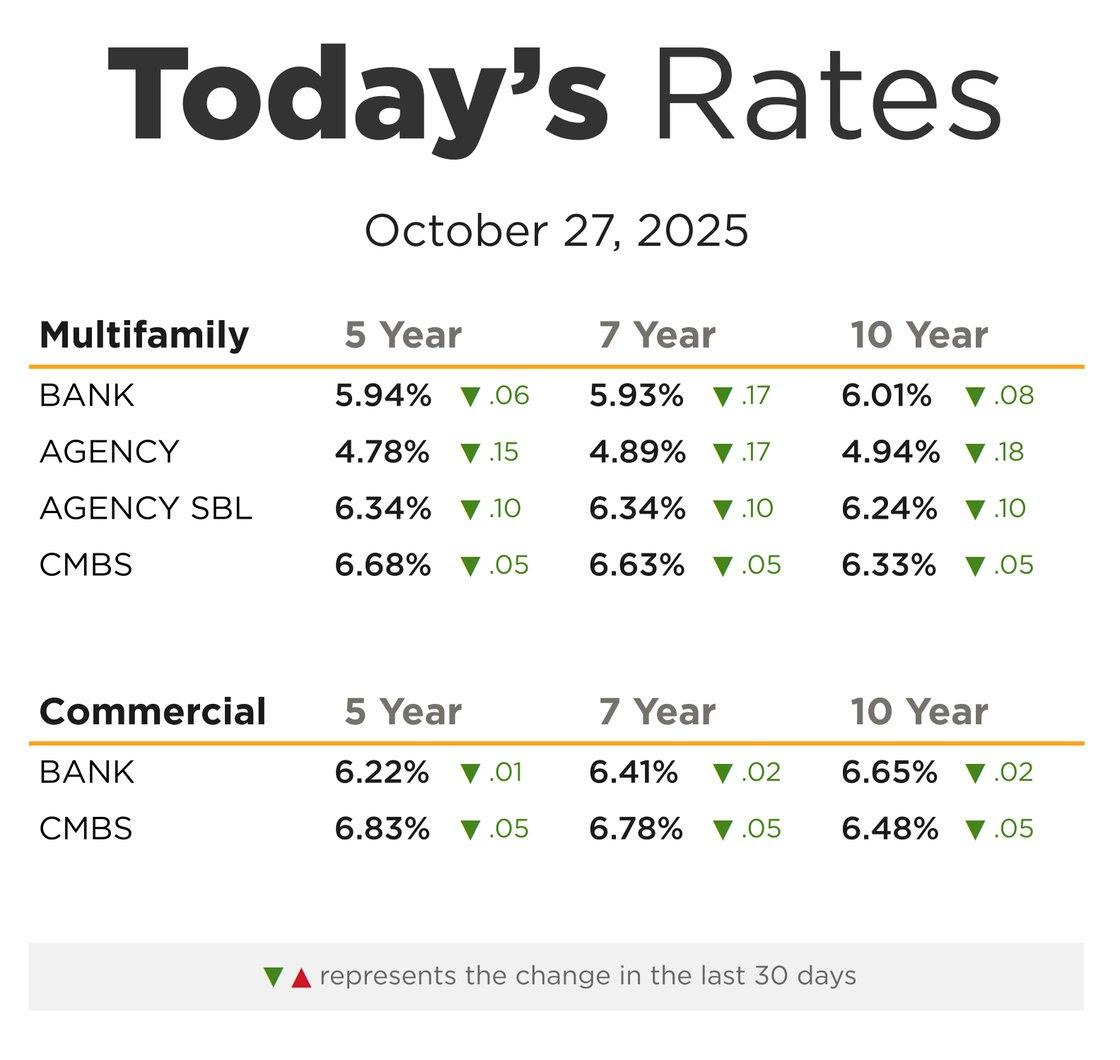
Chicago multifamily mortgage rates are stabilizing with incremental compression across Agency and Bank executions. Capital markets are gradually improving, providing apartment owners and investors with renewed clarity heading into 2026.
This update outlines current multifamily mortgage rates in Chicago and what they mean for refinancing, acquisitions, and valuation strategy.
Multifamily Mortgage Rates – February 2026
| Loan Type | 5-Year | 7-Year | 10-Year |
|---|---|---|---|
| Bank | 5.94% ▼ 0.21 | 5.95% ▼ 0.21 | 6.01% ▼ 0.12 |
| Agency | 4.68% ▼ 0.24 | 4.82% ▼ 0.23 | 4.88% ▼ 0.19 |
| Agency SBL | 6.34% — | 6.34% — | 6.24% — |
| CMBS | 6.85% ▼ 0.02 | 6.80% ▼ 0.02 | 6.50% ▼ 0.02 |
📌 Source: CREConsult Capital Markets | February 2026
📌 Benchmark references: CommLoan Multifamily & Commercial Mortgage Indices
Why Chicago Multifamily Mortgage Rates Matter in 2026
Debt costs directly impact:
- Property valuation
- Cap rate spreads
- Cash flow
- Refinance feasibility
- Acquisition underwriting
With Chicago multifamily mortgage rates showing measured compression, owners now have a clearer window to structure long-term fixed-rate debt before potential Treasury volatility later in 2026.
Current Lending Trends Impacting Chicago Multifamily Owners
1. Agency Loans Lead on Pricing
Agency multifamily mortgage rates in Chicago remain the most competitive:
- 5-Year: 4.68%
- 7-Year: 4.82%
- 10-Year: 4.88%
The spread advantage versus CMBS (over 200 basis points on 5-year terms) reinforces Agency dominance for:
- Stabilized Class A and B multifamily
- Institutional-quality assets
- Suburban core markets
- Non-recourse executions
Fannie Mae and Freddie Mac programs continue to attract capital due to stability and flexible amortization structures.
2. Bank Multifamily Rates Tighten Modestly
Chicago bank multifamily mortgage rates are now:
- 5-Year: 5.94%
- 7-Year: 5.95%
- 10-Year: 6.01%
While pricing has improved by approximately 20 basis points, underwriting remains disciplined:
- DSCR above 1.25x
- Leverage typically 60–65% LTV
- Strong sponsor liquidity required
Banks are competitive on stabilized mid-market properties but cautious on transitional assets.
3. Agency SBL Supports Smaller Assets
Agency Small Balance Loan (SBL) pricing remains stable:
- 5- and 7-Year: 6.34%
- 10-Year: 6.24%
This channel continues to support:
- 5–50 unit apartment buildings
- Workforce housing
- Suburban Chicago markets such as Aurora, Naperville, and Glen Ellyn
SBL remains attractive due to non-recourse options and simplified execution.
4. CMBS Rates Hold Steady
Chicago CMBS multifamily mortgage rates:
- 5-Year: 6.85%
- 7-Year: 6.80%
- 10-Year: 6.50%
Slight tightening suggests improving bond market stability, though pricing remains elevated relative to Agency.
Best suited for:
- Large portfolios
- Cross-collateralized structures
- Higher leverage scenarios
- Long-term hold strategies
Chicago Multifamily Market Fundamentals Remain Resilient
Debt markets are stabilizing while fundamentals remain strong:
- Sub-4% vacancy in core submarkets
- Steady renter demand
- Moderate but sustainable rent growth
- Controlled new supply relative to national averages
Chicago multifamily mortgage rates are no longer volatile — they are predictable. Predictability restores transaction confidence.
Strategic Outlook for Chicago Apartment Owners
Owners should evaluate:
- Refinancing maturing 2026–2027 debt
- Locking fixed-rate loans before Treasury shifts
- Recapitalization opportunities
- Strategic dispositions into improved liquidity
Debt structure is now a competitive advantage.
Work With a Chicago Multifamily Specialist
With over 26 years in multifamily brokerage, I help apartment owners align valuation, capital markets, and exit timing to maximize returns.
If you are considering:
- Refinancing
- Selling
- Recapitalizing
- Evaluating portfolio value
A structured review of your asset and current Chicago multifamily mortgage rates can clarify the optimal strategy.
Receive Market Insights
Periodic analysis on rents, pricing, cap rates, and transaction activity across Chicago and key suburban markets.